
Walking into CNX26, I found myself wondering what Salesforce could possibly announce next.
The reality is that many organisations are still trying to understand what Agentforce Marketing actually means, how Marketing Cloud Next fits into the broader ecosystem, and what the convergence pathways look like for existing Marketing Cloud Engagement (MCE) and Account Engagement (MCAE) customers. There is still a significant amount of education, enablement and adoption work ahead of us as an industry.
What made this year’s Connections particularly interesting for me was that I had the opportunity to spend the Monday before the conference with Salesforce’s product leadership team as part of the Marketing Cloud Partner Advisory Board (PAB), which consists of just 12 partners globally. The day provided a deep dive into many of the innovations, roadmap investments and strategic priorities that would later be announced from the keynote stage.
Because of those discussions, I arrived at the keynote with a slightly different lens.
I wasn’t looking for another dramatic platform reinvention.
I was looking for evidence that Salesforce was continuing to mature and expand the Agentforce Marketing vision it has been building over the past year.
In some ways, I was relieved.
The biggest announcements weren’t another complete reset of the roadmap. Instead, Salesforce focused on extending the platform with practical innovations designed to help customers operationalise AI and move from experimentation to adoption.
And that distinction matters.
More Than 250 Innovations Since CNX25
One of the final slides shown during the keynote highlighted something that deserves recognition: Salesforce has delivered more than 250 marketing innovations since Connections 2025.
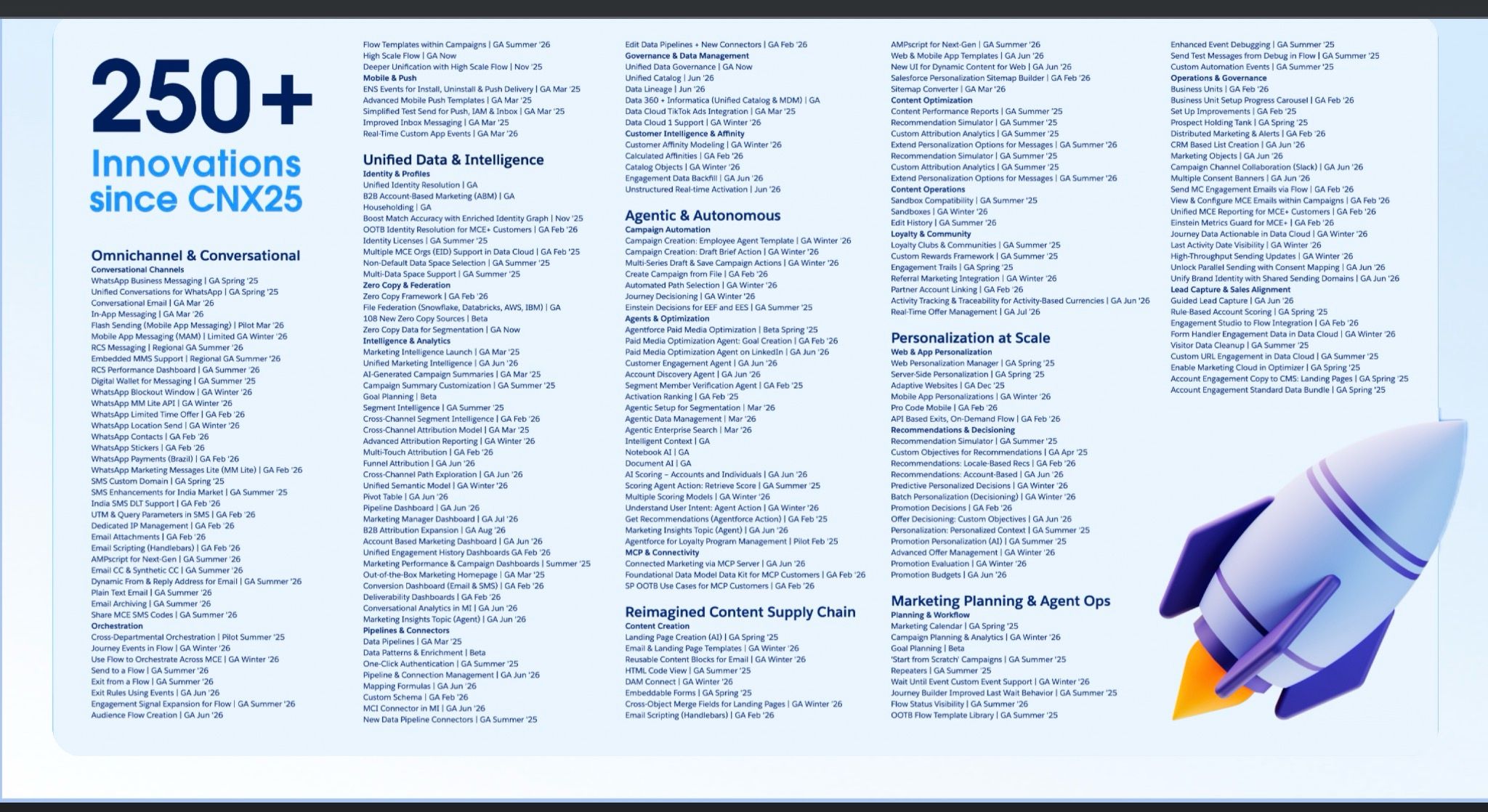
Looking at the sheer volume of releases across content generation, personalization, reporting, intelligence, planning, operations, conversational marketing and autonomous agents, it’s difficult not to appreciate the scale of investment being made.
The slide was a reminder that Agentforce Marketing is not a side project.
Salesforce has committed significant engineering resources, product teams and investment to building what they believe is the future of marketing.
Whether customers are ready to adopt all of it today is another question entirely, but nobody can argue that Salesforce isn’t investing heavily in the space.
The Biggest Announcements
Agentforce Marketing Goals Agent (Pilot)
One of the most interesting announcements was the Marketing Goals Agent, designed to help marketers move beyond campaign execution and instead define business outcomes that agents can optimise against.
Rather than marketers manually configuring every optimisation, the vision is that teams define goals and guardrails while agents continuously work toward those outcomes.
Availability: Currently a limited pilot.
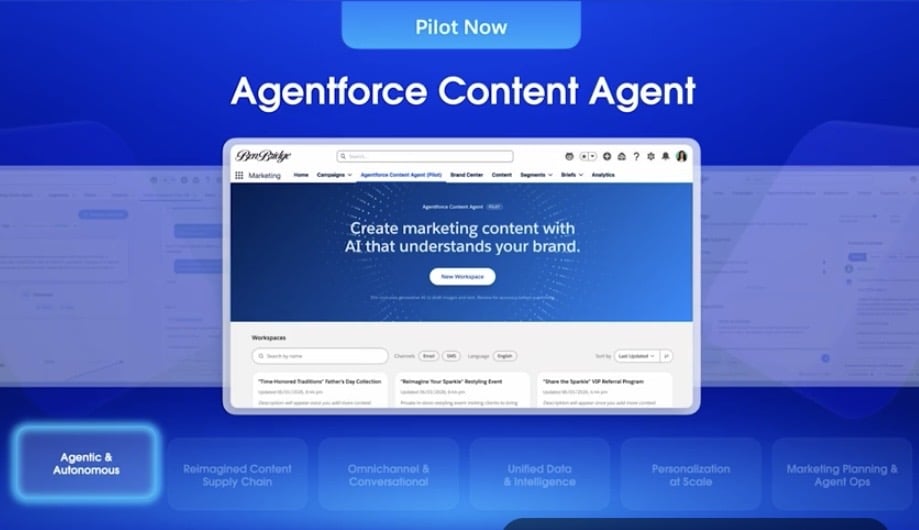
Agentforce Content Agent (Pilot)
The Content Agent was another significant announcement.
Salesforce demonstrated how marketers can generate channel-ready content grounded in campaign briefs, audience context and brand guidelines. The vision is a reimagined content supply chain where marketers spend less time creating variations and more time directing strategy.
Availability: Pilot.
Unified Intelligence
Unified Intelligence was positioned as one of the foundational layers underpinning the entire Agentforce strategy.
Rather than being a single product, it brings together customer data, engagement signals, analytics and business context to provide the intelligence layer that both marketers and agents rely on to make decisions.
This was one of the recurring themes throughout both the PAB discussions and the keynote itself: AI without context is limited. AI with context becomes far more valuable.
Agentforce Coworker
Salesforce continues to reinforce the idea that agents are coworkers rather than simple automation tools.
Throughout the keynote there was a strong emphasis on agents augmenting marketers, helping them become more productive, creative and effective rather than replacing them.
Qualified AI SDR Agent (Available Today)
One of the more mature capabilities demonstrated was the Qualified AI SDR Agent.
Unlike some of the newer pilot innovations, this is available today and already delivering measurable results for customers.
NextGen Healthcare shared that the solution generated $18.9 million in pipeline through more than 30,000 AI-led conversations and over 1,000 meetings booked.
Hunter Prospecting Agent
Salesforce also showcased Hunter, a prospecting agent designed to bridge the gap between marketing engagement and sales execution by identifying and prioritising prospects based on buyer signals and engagement activity.
Marketing MCP Server for Marketing Cloud Engagement
For existing Marketing Cloud Engagement customers, this was arguably one of the most important announcements.
One of the biggest concerns I hear from customers is whether they need to rebuild everything to participate in the Agentforce future.
The answer increasingly appears to be no.
Salesforce is building bridges between today’s platforms and future capabilities, allowing customers to extend existing investments rather than replace them.
Marketing Objects
Marketing Objects stood out because it addresses a very practical challenge: making data available to marketers without extensive technical effort.
It enables marketers to activate and personalise experiences without significant data remodelling projects.
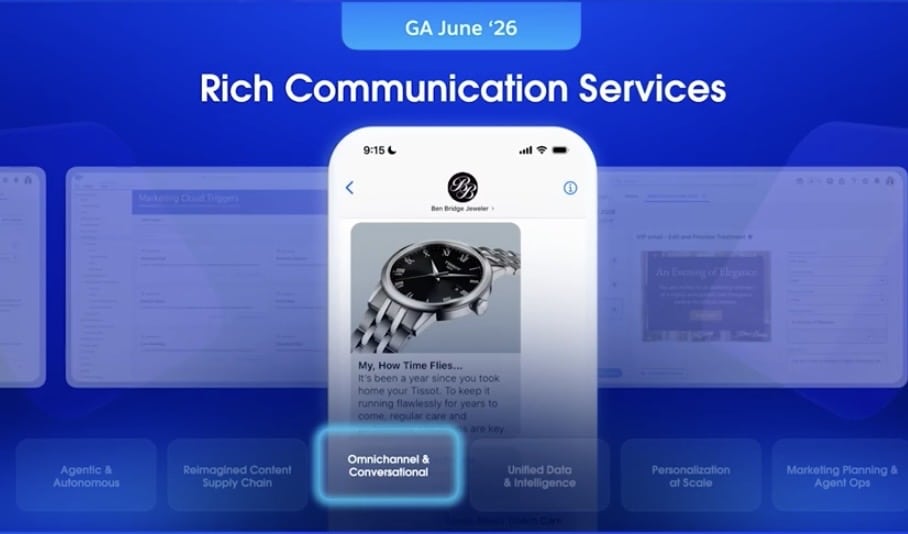
RCS Messaging
RCS was highlighted as the next evolution of mobile messaging.
Unlike traditional SMS, RCS supports richer, more interactive and conversational experiences.
This aligns closely with Salesforce’s broader vision that every channel should become two-way and agent-enabled.
Availability: Region-specific. Availability depends on carrier support, device support and local market maturity.
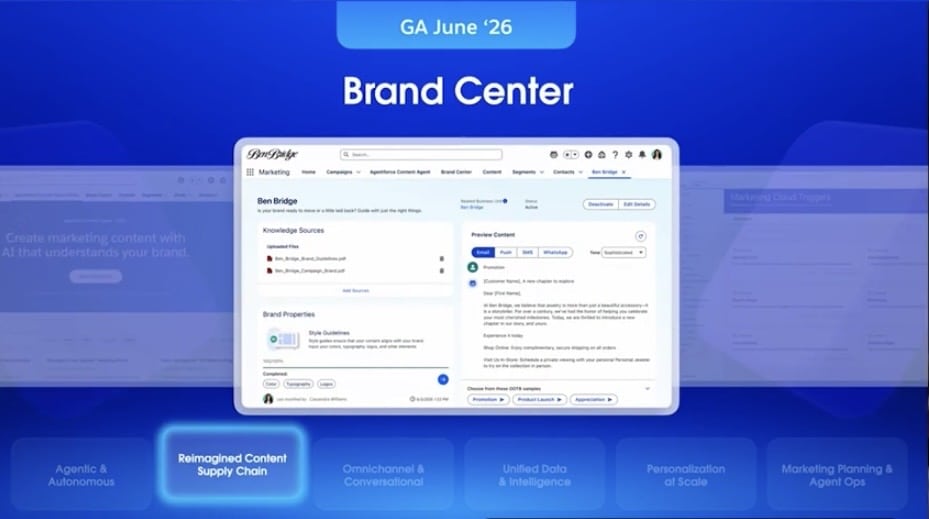
Unified Brand Center
The Unified Brand Center was introduced as a central location for managing brand voice, visual identity and content governance.
As generative AI scales, governance becomes increasingly important.
The Brand Center is Salesforce’s answer to ensuring AI-generated content remains aligned with a company’s identity.
Availability: Early access and closely tied to the Content Agent roadmap.
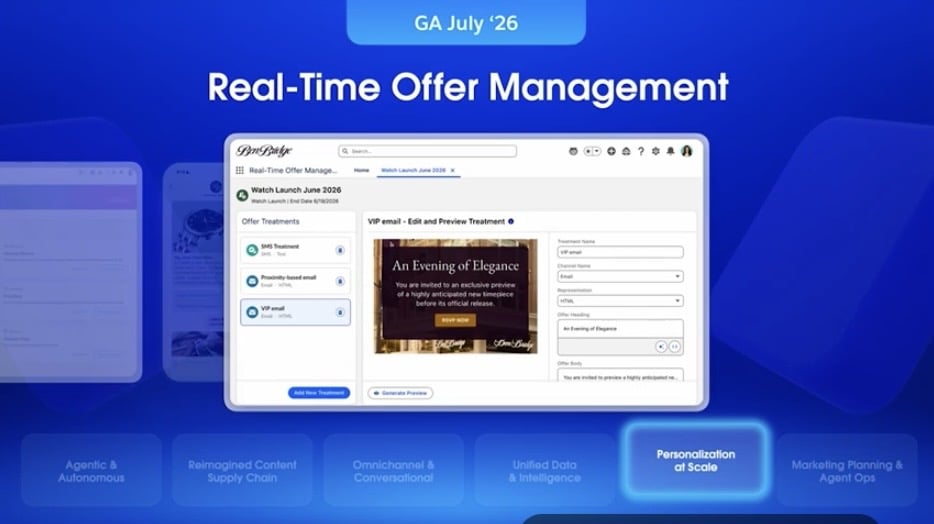
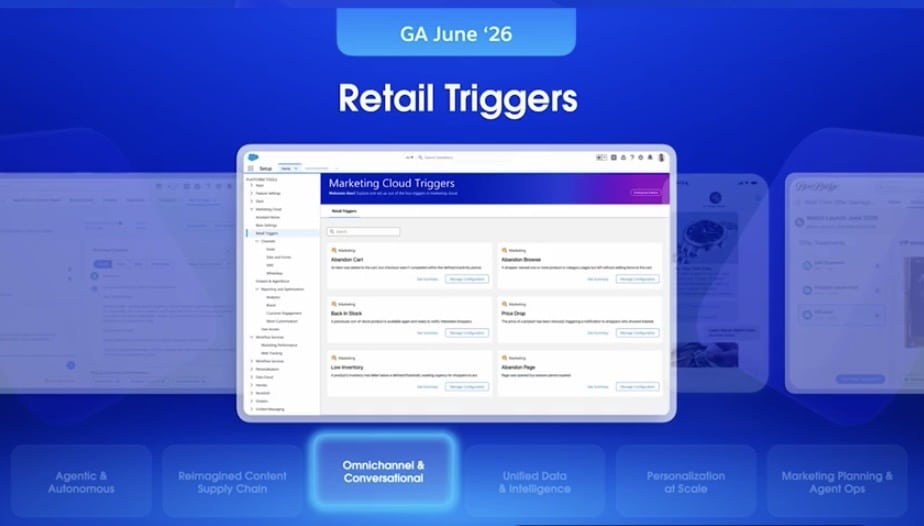
Retail Triggers and Real-Time Offer Management
Salesforce also announced capabilities designed to deliver more dynamic customer experiences based on real-time behaviour and intent signals.
Rather than relying solely on predefined segments and journeys, marketers will increasingly be able to respond to customer behaviour as it happens.
Contentful and the Future of Content
One of the most strategically important themes discussed throughout the week was Contentful.
The integration of Contentful into Salesforce’s broader vision reinforces the idea that content is becoming just as important as customer data.
If Data 360 unifies customer data, Contentful has the potential to become the content layer that powers future agentic experiences across marketing, commerce and service.
The Most Interesting Conversation Didn’t Happen on Stage
What stood out to me most this week wasn’t necessarily what happened during the keynote.
It was a roundtable discussion I attended where customers and partners shared what they are already building.
One example that stayed with me came from a highly regulated industry.
This time last year, many people working in regulated businesses openly questioned how AI could realistically be introduced into their marketing functions.
This year, the conversation was completely different.
One organisation had built automated intelligent reporting using Salesforce APIs and Claude. Every week, brokers receive personalised reports showing how their customers engaged with campaigns, which customers require follow-up and why.
It wasn’t flashy.
It wasn’t a futuristic autonomous marketing department.
It was simply useful.
And that may have been the most powerful example of AI adoption I heard all week.
Another highlight for me was the Agentic Marketing Showdown.
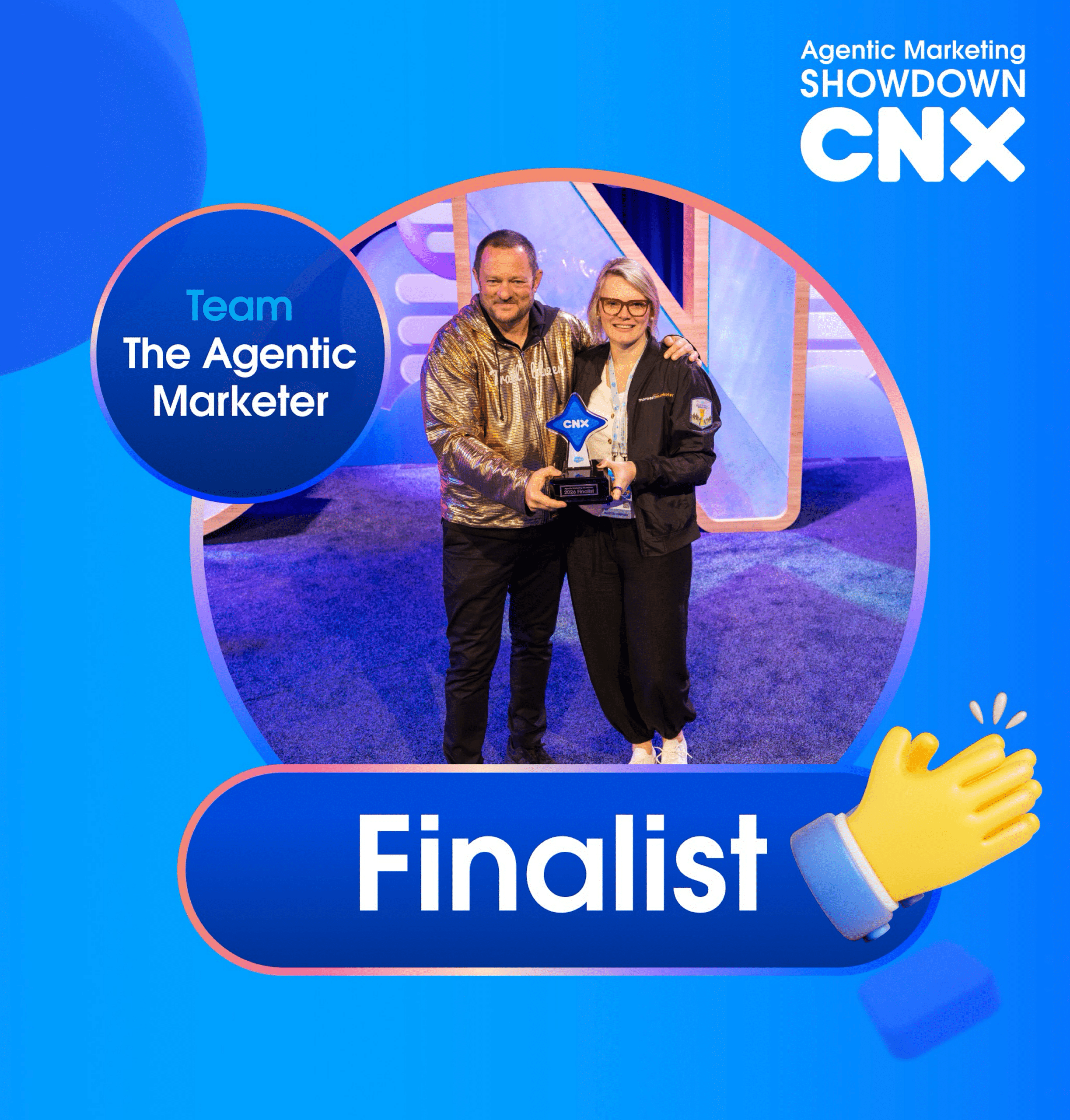
Two fellow Salesforce Marketing Champions and good friends, François Perret and Claudia Hoops, made it through to the final three teams globally. Their entry focused on something many B2B marketers can immediately relate to: the challenge of planning, creating, activating and reporting on webinar campaigns.
What impressed me wasn’t just the concept itself, but the fact that they had actually built it.
Using Salesforce APIs, headless capabilities and Claude, they demonstrated how a marketer could orchestrate an end-to-end webinar campaign without ever needing to log into the Salesforce user interface. From planning and audience selection through to campaign activation and reporting, the entire process was managed through an agentic workflow.
For anyone who has ever run a webinar campaign, the value is immediately obvious. What can often take days or even weeks of coordination across multiple systems, teams and interfaces can potentially be reduced to a fraction of the effort.
While there were some incredibly creative entries in the competition, many focused on visionary concepts of what might be possible in the future. What stood out to me about François and Claudia’s submission was that it provided tangible proof of what is possible today. It wasn’t a concept. It wasn’t a prototype. It was a working example of how agentic marketing can solve a real business problem.
They ultimately finished in third place, but from my perspective they were still winners.
Their solution perfectly demonstrated one of the biggest themes I took away from CNX26: the future of marketing won’t be defined by the number of AI announcements we hear on stage. It will be defined by marketers who take these technologies and apply them to practical use cases that create real value for their teams and customers.